

Growing an agency creates a predictable problem: winning more client work does not automatically create more delivery capacity. SEO outsourcing gives a business access to specialists without immediately adding another full-time role, software seat, training program, and layer of payroll.
The SEO delivery model can be narrow or broad. You might outsource SEO for a technical audit, content production, or link building. Or you might use a partner for recurring execution across several client accounts while your team keeps strategy, sales, and the client relationship.
The goal is not to hand away SEO control. Good SEO outsourcing creates a clear division of responsibility while supporting broader marketing goals: your team owns the commercial relationship and priorities, while the external partner completes defined work to an agreed standard.
What Does Outsourcing SEO Actually Mean?
Outsourcing SEO means using an external freelancer, specialist, or agency to complete some or all of the work required to improve organic search performance.
That can include SEO research, technical SEO, content, on-page SEO, local search, reporting, and authority development. This model is especially useful when internal teams lack the bandwidth, resources, or tools to execute an effective strategy.
For a reseller, the model often becomes white-label SEO: the partner works behind the scenes while your firm stays client-facing. You may also see white label delivery used when the work is produced under your branding. Some vendor directories use optimization outsourcing to describe the broader practice.
The practical question is not whether outside SEO help is good or bad. It is which responsibilities should stay with your team and which are safe to delegate.
Which SEO Tasks Should You Outsource?
Certain SEO tasks are easier to scope, review, and repeat than others.
- Technical audits. An SEO specialist can crawl the site, identify indexation and architecture issues, prioritize fixes, and provide developer-ready recommendations.
- Content production. Briefs, landing pages, blog posts, refreshes, and supporting assets can be produced externally when brand guidelines and approval standards are clear.
- Link building. Outreach-heavy work can consume large amounts of internal time. A vetted SEO partner can handle prospecting, outreach, quality review, and placement reporting.
- Local search work. Citation cleanup, profile optimization, location-page support, and recurring tasks are often process-driven enough to externalize.
- Reporting and implementation support. Repetitive analysis, data collection, schema work, and technical tickets can be handled outside the core team while senior staff focus on recommendations.
The more measurable the deliverable, the easier it is to outsource SEO services without losing strategic control. Strategic decisions become harder to externalize when the provider lacks context about the customer, product, market, or account history.
When Should an Agency Outsource SEO Services?
There are three strong signals.
First, demand is outpacing capacity. Your team can sell more SEO services than it can reliably deliver.
Second, hiring a specialist for every capability does not make financial sense. You may need technical expertise this month, ten articles next month, and a heavier authority campaign after that. A full-time employee locks the business into fixed overhead regardless of workload.
Third, senior people are spending too much time in production. When founders and strategists are formatting reports, chasing writers, or manually checking routine work, the agency has a systems problem.
At that point, using outside talent can protect capacity without forcing you to hire ahead of revenue.
Search Brilliance is designed around this model. Agencies can keep control of strategy, communication, and pricing while using a behind-the-scenes partner for execution across content, technical work, local SEO, link building, digital PR, search marketing, and AI-search visibility.
What Costs Should You Compare Before Outsourcing?
Cost comparisons should include more than the invoice from a freelancer or partner.
Start with direct costs, then add internal review time, project management, software, revisions, missed deadlines, and the financial risk of poor client work. A cheap vendor can become expensive when a senior employee spends several hours correcting every deliverable.
Compare that with an employee. The internal model adds salary, benefits, recruiting, onboarding, tools, training, and management. An external partner converts more of that fixed expense into variable spend tied to actual work.
The right SEO model depends on utilization. If you have enough stable volume to keep a specialist productive every week, internal hiring can make sense. If demand changes by client or service, outside support may provide better flexibility.
White Label SEO vs. Freelancers vs. In-House
There is no universal winner.
| Model | Best when | Tradeoff |
|---|---|---|
| Freelancer | One skill or a defined project | You coordinate more people as volume grows |
| Specialist partner | Broader delivery capacity and QA | Requires the right operating fit |
| White-label partner | Work delivered under your identity | Ownership and confidentiality must be defined |
| In-house team | Predictable workload, deep cross-team work | Fixed payroll and management overhead |
A strong agency may use all four SEO delivery models at different times. If you plan to resell at scale, the deeper playbook is in SEO Reseller Services.
How Do You Choose an SEO Provider?
Start with examples of real deliverables. A polished SEO sales deck is less important than seeing the audit, article, report, or outreach result your client would actually receive.
Ask how quality is checked. Reliable SEO providers should be able to explain who does the work, who reviews it, what happens when a deliverable misses requirements, and what is included in revisions.
Review communication expectations. Define turnaround times, approval steps, escalation procedures, and who owns client-facing messaging.
Check the commercial model. Understand minimum commitments, markups, ownership of work, cancellation terms, and whether the partner can scale with your account volume.
Finally, judge expertise rather than geography. Location matters far less than process, communication, relevant experience, accountability, and evidence. Compare providers directly in our Search Brilliance vs alternatives library.
How Do You Build a Reliable SEO Outsourcing Workflow?
The best SEO delivery relationships are operationally boring.
Create a standard brief containing the URL, business goals, audience, competitors, priorities, brand rules, access requirements, and definition of done.
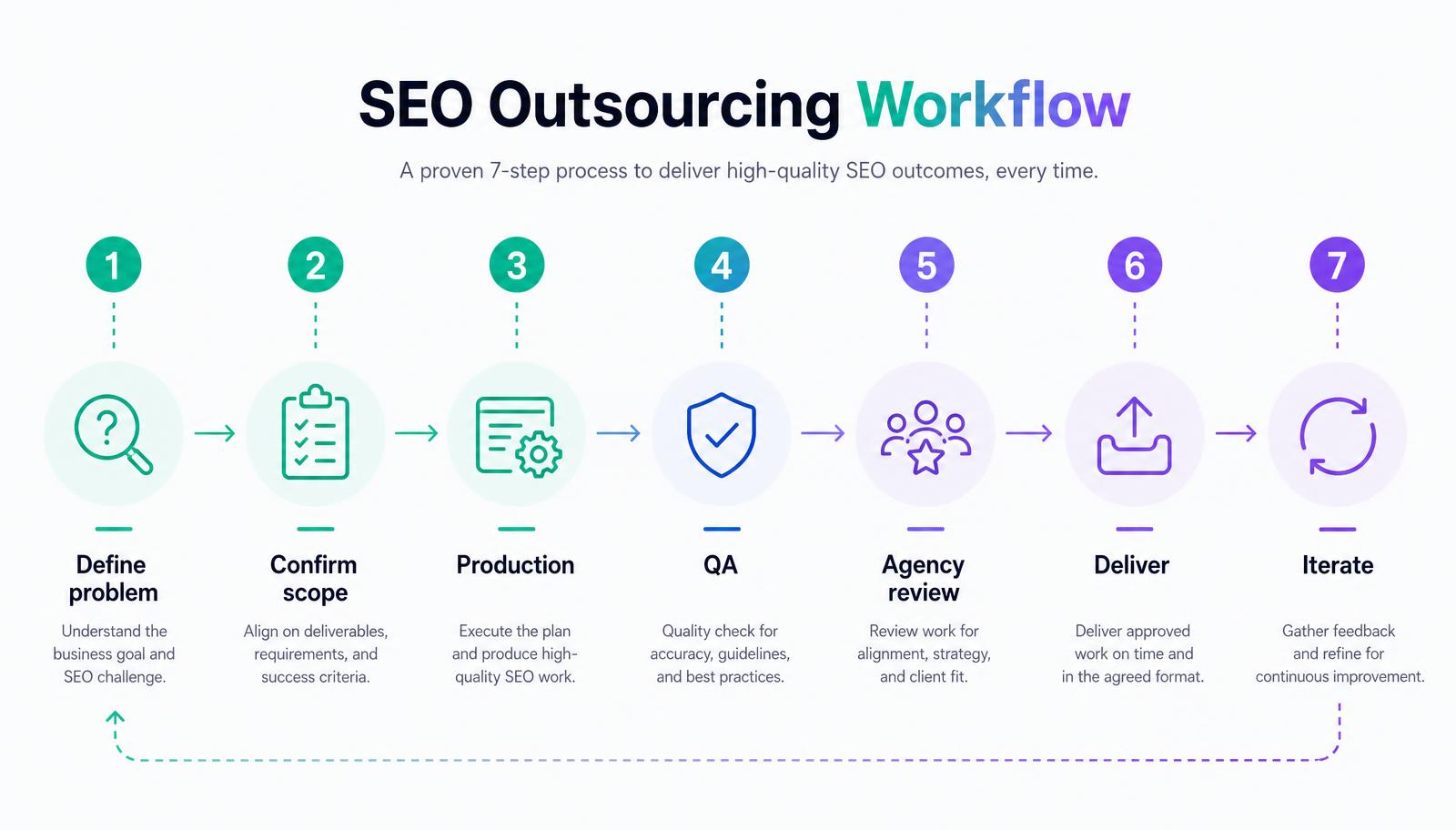
Then use a consistent workflow:
- Your team defines the problem and expected outcome.
- The partner confirms scope and required inputs.
- Production begins.
- Work passes internal quality control.
- Your team reviews only the decisions that require client context.
- Approved work is delivered or implemented.
- Performance informs the next cycle.
This is where SEO fulfillment becomes more valuable than random task outsourcing. The partner is not simply completing tickets; it becomes a repeatable execution layer. Teams that want the whole system packaged can plug straight into Grow retainer packages or managed SEO growth.
Search Brilliance follows that logic by allowing partners to use individual services or combine them into broader delivery. That makes it possible to delegate SEO production without giving up the strategy or client relationship.