
How to Get SEO Clients: A Repeatable System for Agency Growth
A practical playbook for finding, qualifying, and closing SEO clients without relying on referrals — niche selection, prospecting, outreach, audits, and closing.

How Do You Get SEO Clients Without Relying on Referrals?
The strongest approach is to avoid relying on one channel. If you are researching how to get SEO clients, start by narrowing the market and defining a clear offer. Your ideal clients are companies with a measurable problem, enough commercial upside to justify recurring SEO, and a realistic reason to act.
Use SEO content, referrals, partnerships, targeted outreach, and proof from previous work. Create pages around the niches and services you want to sell, then support them with case studies.
At the same time, find potential clients through directories, communities, and LinkedIn. This gives you more ways to get SEO clients and creates a client base that is not dependent on referrals alone. A repeatable mix of inbound and outbound activity is usually stronger than chasing one tactic.
What Should an SEO Prospect Look Like?
A good SEO prospect has both an identifiable problem and a business case for fixing it. Look for weak organic search rankings, poor conversion paths, outdated content, missing location coverage, technical problems, or competitors capturing valuable demand.
Semrush and similar tools can help find gaps, but the tool is only the starting point. Qualify the company by budget potential, customer value, urgency, decision-maker access, and whether your SEO services match the problem.
For a local business, review Google Business Profile quality, reviews, landing pages, citations, and local SEO fundamentals. The best potential clients are not simply websites with errors; they are companies where better SEO could plausibly create meaningful commercial value.
How Does Client Acquisition Work for SEO Agencies?
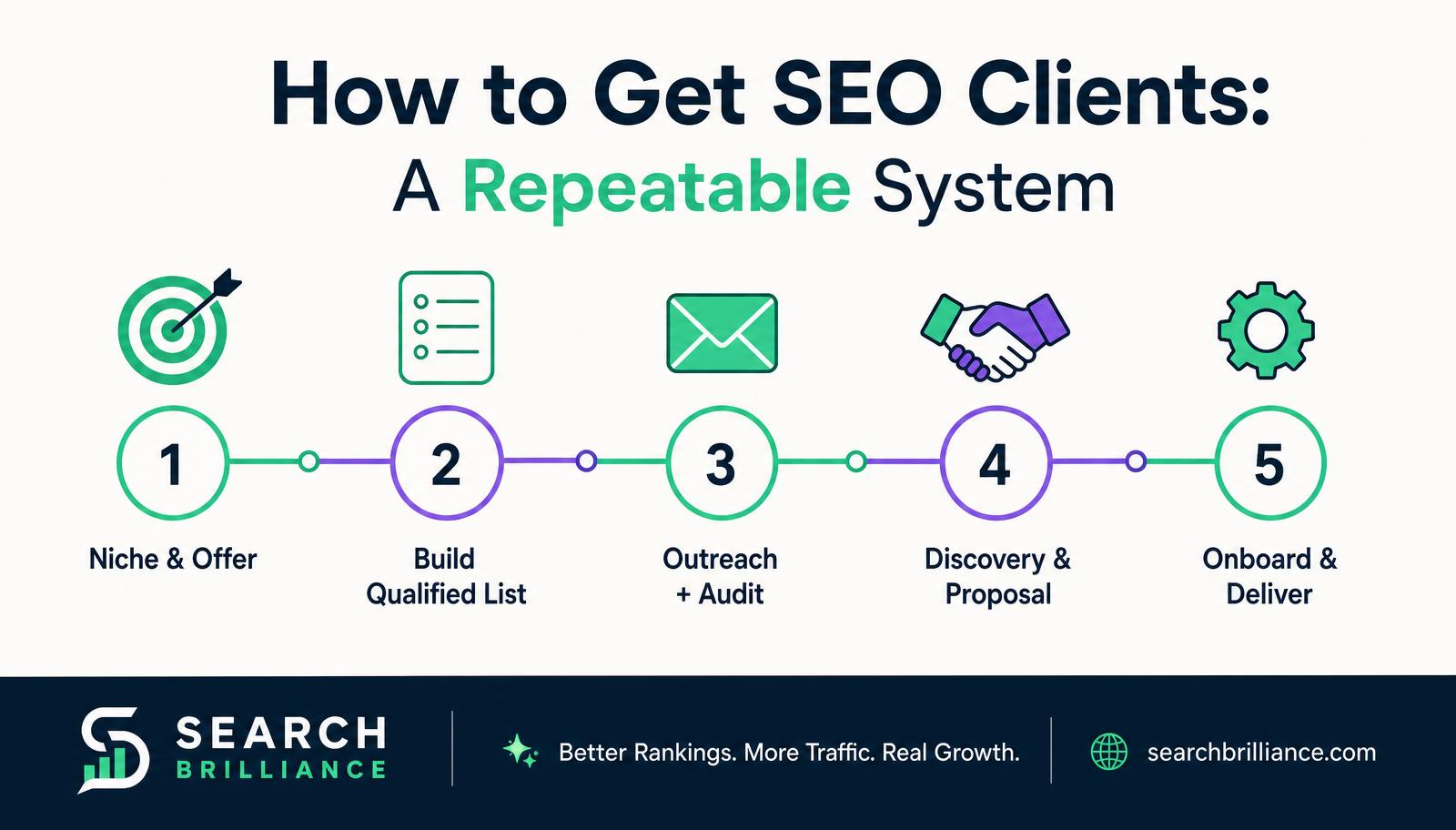
Client acquisition should operate as a process rather than a series of random sales pushes. Define the niche, build a qualified list, research each company, start relevant outreach, run discovery, send one clear proposal, and agree on scope.
An SEO agency should track which channels create leads, meetings, and closed SEO clients. That information helps the company invest in the marketing activities producing actual revenue.
Before fulfillment begins, standardize the contract, payment method, invoice workflow, onboarding, and handoff into delivery. This reduces friction as volume grows.
The goal is not merely to attract clients. The goal is to build a system that can turn qualified conversations into recurring SEO revenue while protecting margins and delivery quality.
Why Target Local Businesses for SEO?
Local businesses can be attractive targets because better visibility can translate into calls, bookings, consultations, and store visits.
Choose industries where one new customer is valuable enough to support recurring SEO services. Then identify companies with weak Google profiles, thin location pages, poor reviews, inconsistent citations, or competitors dominating commercial queries.
A niche focus also makes outreach easier. You can reuse research frameworks, audit templates, proof, and marketing angles while still personalizing the message.
Instead of pitching generic SEO, demonstrate where the company is losing visibility and explain how your services address that specific opportunity. For location-driven companies, local SEO can be easier to connect to revenue than broad awareness work.
Should You Prospect Daily for SEO Leads?
Consistency matters. Set a daily routine for prospect research, outreach, follow-up, and pipeline updates rather than doing sales only when revenue slows down.
Each cold message should have a reason for existing. Mention a real issue, missed opportunity, competitor advantage, technical problem, or conversion gap. That makes the conversation more relevant than a generic pitch.
Track leads, replies, meetings, sales stages, and closed SEO clients. Those numbers show whether the bottleneck is targeting, messaging, qualification, or closing.
The objective is not maximum activity. It is a repeatable method for producing each new SEO lead while maintaining enough personalization to earn attention.
How Do You Turn an Audit Into a Client?
A good audit creates clarity instead of dumping hundreds of errors on a company.
Choose a small number of findings that connect to traffic, rankings, conversions, or revenue. Explain what is wrong, why it matters, what should happen first, and where the opportunity sits.
An audit can make cold outreach more credible because you are demonstrating expertise before asking for a meeting. It also gives potential clients something concrete to evaluate.
Use the audit to turn a vague sales conversation into a prioritized business discussion. Keep the recommendations useful even if the company does not hire you. That builds trust and makes the value of professional SEO services much easier to understand.
Should You Offer Free Social Business Page Creation?
This can work as a low-friction entry offer when it connects naturally to a broader need. You might offer free social business page creation when a company has an incomplete presence, then identify gaps in website visibility, content, reputation, or SEO.
Social media can also warm up later outreach. Follow decision-makers, engage intelligently with their content, and create familiarity before contacting them directly.
The free work should be limited and strategically useful. Do not give away so much labor that the acquisition model becomes unprofitable.
The purpose is to create a credible first interaction, demonstrate marketing competence, and open the door to larger SEO services rather than making free work the core offer.
Which Marketing Channels Work Best for SEO?
A strong mix usually combines inbound and outbound marketing.
Inbound can include SEO content, referrals, partnerships, case studies, communities, and educational assets. Outbound can include cold email, calls, LinkedIn prospecting, direct messages, and targeted email outreach.
Use inbound to capture buyers already evaluating providers and outbound to find companies that fit your profile before they request help. Both can generate leads.
For cold email, reference a real observation and focus on the prospect''s problem instead of sending a generic menu of offerings.
A freelance consultant can use the same model at smaller scale: publish proof, establish expertise, choose a narrow market, and maintain consistent outreach. Combining channels reduces dependence on any single source of opportunity.
How Should Agencies Use LinkedIn for SEO Sales?
LinkedIn is useful for identifying decision-makers, researching companies, demonstrating expertise, and starting B2B conversations.
Use LinkedIn or Sales Navigator to find potential clients by role, industry, geography, seniority, and company characteristics. Review the account before reaching out so the message has a genuine reason behind it.
Avoid opening with a long SEO pitch. Lead with an observation, relevant question, or useful idea. Publish case studies, short SEO lessons, industry findings, and examples of problems you have solved so buyers can assess your expertise before replying.
This combination of prospecting and visible credibility can support both outbound conversations and inbound SEO clients.
What Tools Help Build a Strong Client Pipeline?
You do not need dozens of tools, but you do need an organized system.
Use SEO research tools to identify opportunities, a CRM to manage conversations, email software for follow-up, and analytics to understand which channels create qualified leads. Search Brilliance can support fulfillment once those clients need scalable delivery.
Track the company, contact, identified problem, outreach date, response, meeting stage, next action, and eventual outcome. Then build templates for audits, discovery calls, onboarding, and reporting.
Good tools improve execution, but they do not replace positioning or proof. The fastest route to more SEO clients is a clear market, a credible offer, disciplined outreach, and SEO delivery that solves a problem buyers already value.