

The Complete Guide to White Label SEO for Agencies
Selling search is often easier than delivering it at scale. A client asks whether you can improve organic visibility, fix technical problems, publish better pages, strengthen authority, or help the brand appear in AI-driven search. Saying yes creates revenue. It also creates an operational question: who is going to do the work, how will quality be controlled, and can your team deliver it without adding permanent overhead every time sales increase?
That is where white label SEO services become a real operating advantage. Instead of building every capability internally, your firm can use a specialist team behind the scenes while keeping control of strategy, communication, client relationships, and the commercial offer.
Done well, white label is not simply a cheaper way to buy SEO — it is a way to build a more flexible delivery system. Done poorly, it creates revisions, delays, weak work, and another vendor your team has to manage. This guide explains how the model works, what can be delegated, how to protect margins, and how modern search delivery is changing as Google, ChatGPT, Perplexity, and other discovery platforms become part of the customer journey.
What Are White Label SEO Services?
White label SEO services allow one firm to sell search optimization under its own brand while another company performs agreed work behind the scenes. Your client hires you. You control the relationship. You define the commercial offer. The outside team handles execution.
In a mature arrangement, a specialist team can support technical work, keyword research, on-page improvements, local search, content production, authority development, and other search tasks without becoming the visible brand in the client relationship.
You are not referring the client to another firm. You are adding production capacity to your own business.
How White Label SEO Works Behind Your Brand
The basic operating model is straightforward. Your firm wins the account, sets expectations, gathers the client information, and decides what needs to be done. The outside team receives a brief, completes the agreed work, performs quality checks, and returns the deliverables to you. You review what matters and deliver the work under your own brand.
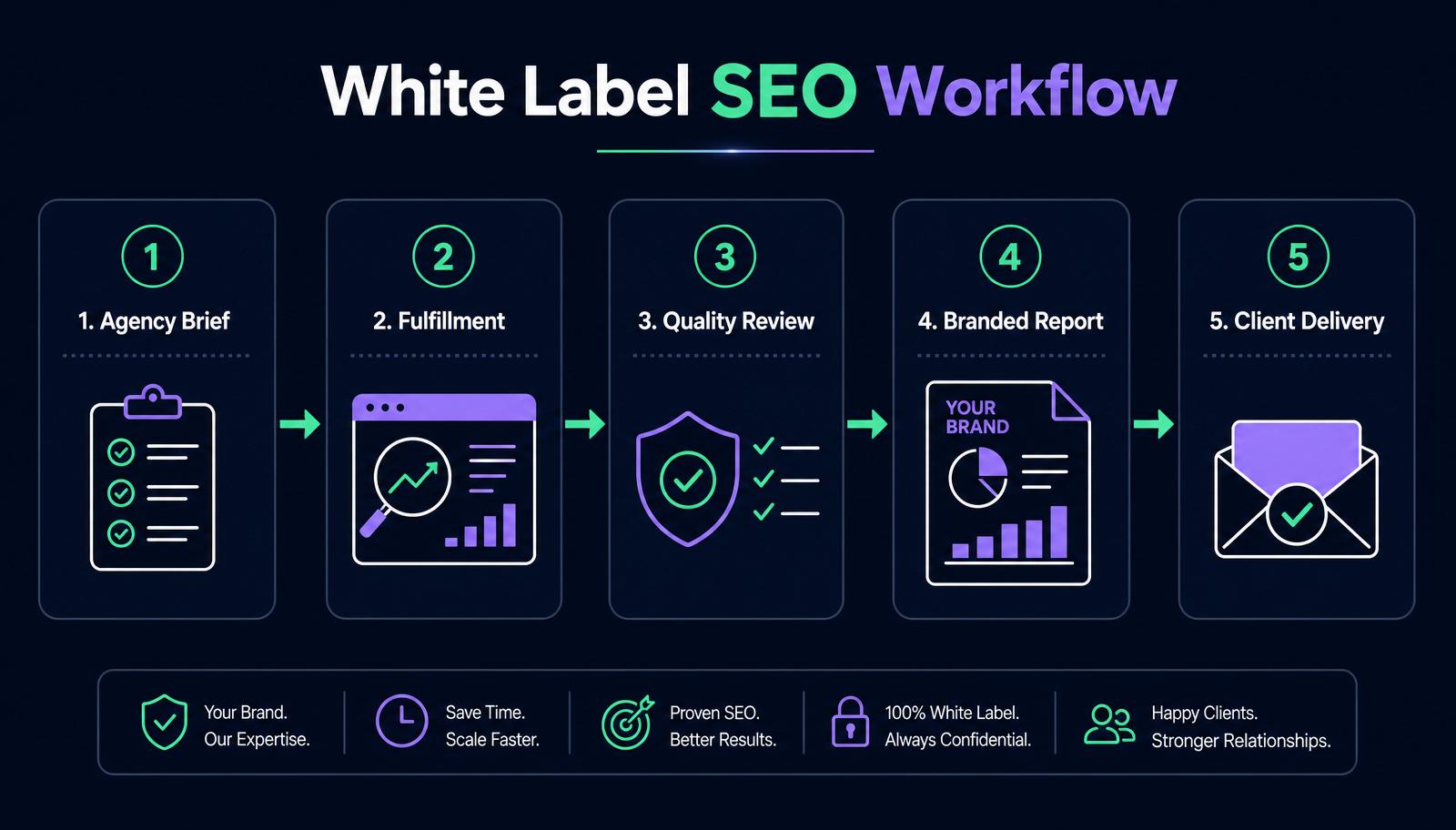
| Stage | Your firm | Partner |
|---|---|---|
| Sales | Owns | Supports when needed |
| Discovery | Owns | Reviews inputs |
| Strategy | Leads | Supports |
| Production | Oversees | Executes |
| Quality control | Reviews | Performs |
| Client communication | Owns | Stays behind the scenes |
| Performance analysis | Leads | Supports |
| Renewal | Owns | Supports with data |
The best arrangements feel like an extension of your operation rather than a collection of disconnected contractors.
When an SEO Reseller Program Makes Sense
An SEO reseller program makes sense when demand is growing faster than your internal production capacity. That can happen to an established agency that already has client relationships but lacks a dedicated search department. It can also happen to web design firms, digital marketing teams, paid media shops, branding consultancies, or solo consultants that keep hearing the same question from existing clients: “Can you handle SEO too?”
| Delivery model | Main advantage | Main tradeoff |
|---|---|---|
| In-house team | Maximum control | Higher fixed payroll and management |
| Freelancers | Flexible specialist help | More vendor coordination |
| White label partner | Flexible capacity and broader expertise | Requires the right operating partner |
What Agencies Can Delegate
The strongest model is not necessarily “send everything outside.” Many agencies keep strategy, sales, and client communication internally while delegating production-heavy work. The right structure depends on where your bottleneck is.
Technical SEO and Audits
Technical SEO audits cover crawl analysis, indexation review, redirects, canonicalization, XML sitemap review, robots directives, Core Web Vitals, internal architecture, structured data, and schema implementation. The strongest audits do more than export errors from software — they prioritize issues by likely business impact and give the client or development team a clear path to implementation.
Keyword Research and On-Page Work
Search research can include keyword discovery, intent analysis, competitor research, keyword mapping, existing-page analysis, and internal linking recommendations. The objective should be commercial relevance, not simply producing a larger keyword list. A page ranking for the wrong query does not create meaningful growth.
Content Production
Content is one of the easiest areas to scale with an outside team, but it is also one of the easiest places to accept mediocre work. A strong process can support blog articles, service pages, landing pages, location pages, product descriptions, category pages, resource guides, and existing-page refreshes.
Link Building and Outreach
A partner may support guest posting, editorial placements, niche edits, digital PR, expert commentary, and targeted outreach. Link building should never be judged by volume alone — evaluate relevance, editorial standards, placement context, anchor usage, and risk.
Local SEO
Google Business Profile optimization, citation work, NAP consistency, location-page improvements, and review strategy — especially valuable for attorneys, medical practices, contractors, home-service businesses, and franchises.
Digital PR and Brand Authority
Modern search authority increasingly overlaps with broader brand authority. Digital PR, media placements, and press release distribution can support media coverage, expert commentary, and earned mentions that strengthen discovery.
AI Search Visibility
Clients are increasingly asking whether they appear in ChatGPT, Google AI experiences, Perplexity, Gemini, and other answer engines. That creates new work around AI visibility audits, citation analysis, brand mention development, entity consistency, structured data, and community mentions. This does not replace traditional SEO — it expands the surfaces that need to be considered.

Full-site crawl, indexation, Core Web Vitals and prioritized dev-ready fixes.

Structured data that unlocks rich results and AI citations.

Long-form articles optimized for Google and AI answer engines.

Conversion-first copy for money pages and campaign launches.

On-brand copy for full site rebuilds and page refreshes.

Unique, keyword-mapped copy at ecommerce scale.

Editorial guest posts on real, vetted sites — delivered under your brand.

Contextual link insertions from indexed pages with topical relevance.

Expert quotes placed in top-tier publications, cited and linked.

Story-driven campaigns that earn brand mentions and authority links.

Direct placements in industry-relevant publications with editorial links.

Newswire syndication with premium tier options and reporting.
Full GBP buildout, categories, services, posts, and Q&A hygiene.

NAP-consistent listings on the directories that move the map pack.

Templated review requests and reputation monitoring for clients.

Listicle placements that get your brand cited by ChatGPT, Perplexity and AI Overviews.

Reddit, Quora and niche forum mentions that feed AI training data.

Fully packaged retainers combining links, content and technical SEO.
How SEO Fulfillment Should Work
SEO fulfillment should be a system, not a pile of completed tasks. The purpose of an outside partner is to turn strategy into repeatable, reviewable work without increasing your internal management burden at the same pace as sales.
A good process should answer:
- What information is required before work starts?
- Who owns each step?
- How are deadlines tracked?
- What quality checks happen before delivery?
- How are revisions handled?
- How is work documented?
- How does the next task connect to the broader strategy?
The task itself may be completed, but the delivery process can create enough friction that your internal team still spends hours fixing formats, clarifying recommendations, chasing status updates, or rebuilding deliverables. The best relationships reduce that friction.
What White Label Reporting Should Include
Reporting should explain performance, not simply export metrics. A useful client update should answer four questions:
- What changed?
- What work was completed?
- Why does it matter?
- What happens next?
Depending on the scope, reporting may include organic visibility, search traffic, conversions, leads, priority query movement, landing-page performance, technical improvements, authority gains, completed work, and AI visibility where relevant.
Pricing, Margins and the SEO Reseller Model
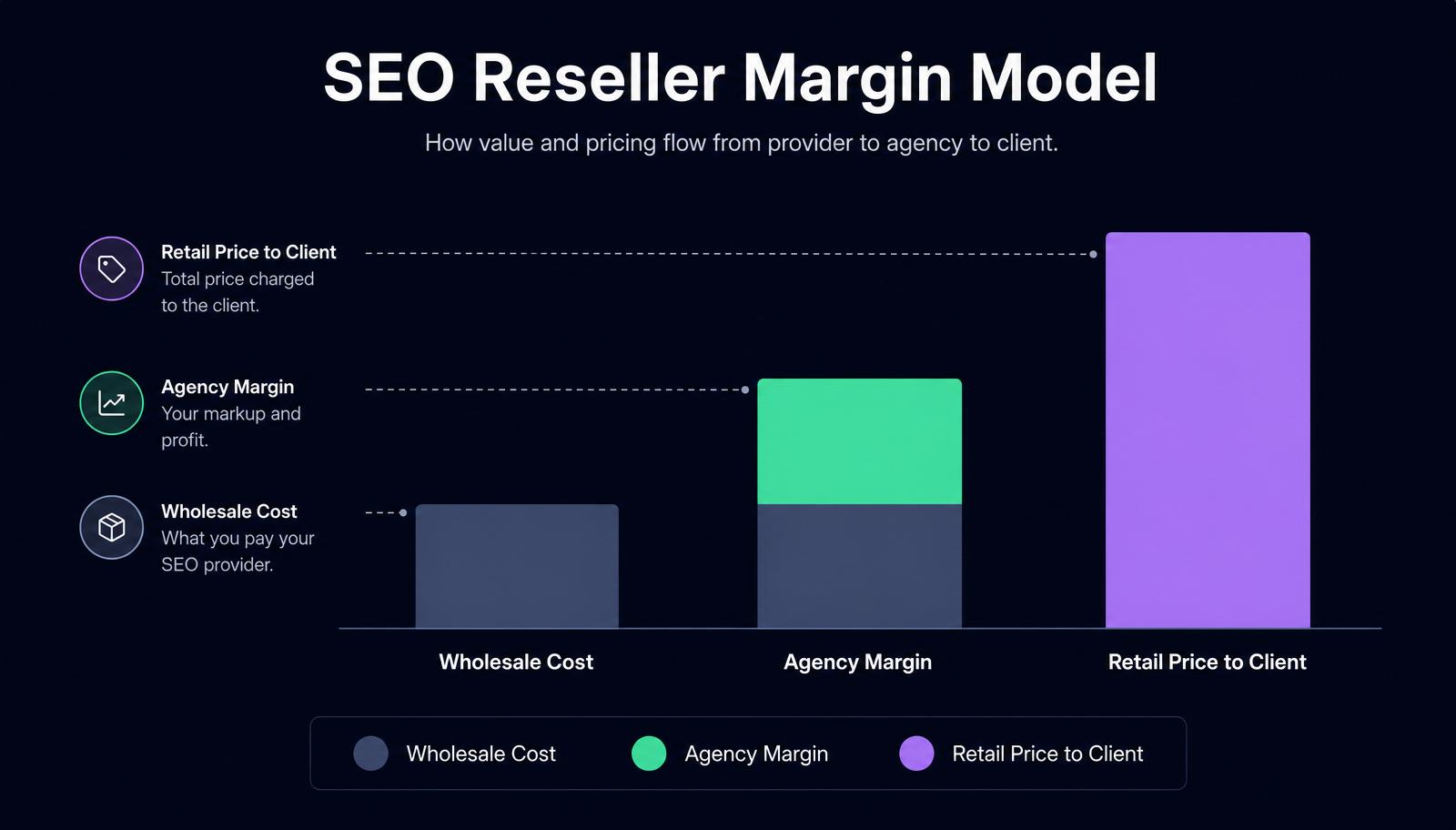
The right question is: what does the work really cost after internal management is included? Consider two providers:
| Cost | Provider A | Provider B |
|---|---|---|
| Vendor fee | $500 | $750 |
| Internal QA | $200 | $50 |
| Revisions | $150 | $0 |
| Project management | $100 | $50 |
| True cost | $950 | $850 |
Provider A looks cheaper until the internal workload is included. A better formula:
True Delivery Cost = Vendor Fee + Internal QA + Revisions + Project Management + Delay Cost
Weighing partners? See how we compare in our side-by-side reseller comparisons.
How Search Delivery Changes in the AI Search Era
The customer journey is becoming less linear. A potential buyer may begin with Google, ask ChatGPT for recommendations, compare companies in a listicle, read Reddit discussions, visit review sites, and then return to branded search before converting. That does not make SEO less important — it makes search strategy broader.
| Traditional focus | Broader search visibility |
|---|---|
| Keyword positions | Search + answer visibility |
| Website authority | Website + brand authority |
| Backlinks | Earned authority + citations |
| Blog production | Useful, extractable answers |
| Google discovery | Google + AI discovery |
| Technical optimization | Technical quality + entity clarity |
| Authority development | Digital PR + community visibility |
How Agencies Should Package the Service for Clients
Do not sell a pile of tasks. Clients rarely care that they received four articles, three citations, and a technical checklist. They care about business outcomes. Build the offer around the problem:
- Local Growth — combine GBP work, location-page optimization, citation cleanup, and supporting content.
- Organic Growth — combine research, technical work, existing-page improvements, new content, and authority.
- Ecommerce Growth — combine ecommerce technical analysis, category-page improvements, product-page optimization, internal architecture, and link building.
- AI Visibility — combine AI visibility audits, citation analysis, structured data, brand mentions, and digital PR.
Teams that prefer a fully packaged retainer can plug directly into Grow retainer packages or managed SEO growth. If you are still deciding what to keep in-house versus delegate, start with the SEO outsourcing guide — and review real client outcomes before committing.
Questions to Ask Before You Commit
- What exactly is included?
- Who performs the work?
- How is quality checked?
- What is the normal turnaround?
- How are revisions handled?
- Can we approve important work before delivery?
- Are deliverables client-safe?
- Who owns completed work?
- Can we export performance data?
- How do you approach AI search?
- What happens when something goes wrong?
The last question is especially useful. Every provider can explain the happy path — the better ones can explain how they recover when the process breaks.
Build the Agency, Not Another Bottleneck
The purpose of white label is leverage. It should help your firm add capacity without turning every new sale into another hiring decision. It should give specialists the work they are best equipped to perform. It should protect the client relationship. And it should leave enough commercial room for your business to grow.
The wrong partner adds management. The right one adds capability.